GEOTECHNICAL ENGINEERING
HAMPTON VIRGINIA
HomeUnderground ExcavationsGeotechnical analysis for soft soil tunnels

Geotechnical Analysis for Soft Soil Tunnels in Hampton, Virginia

Rigorous testing. Clear reporting.

LEARN MORE

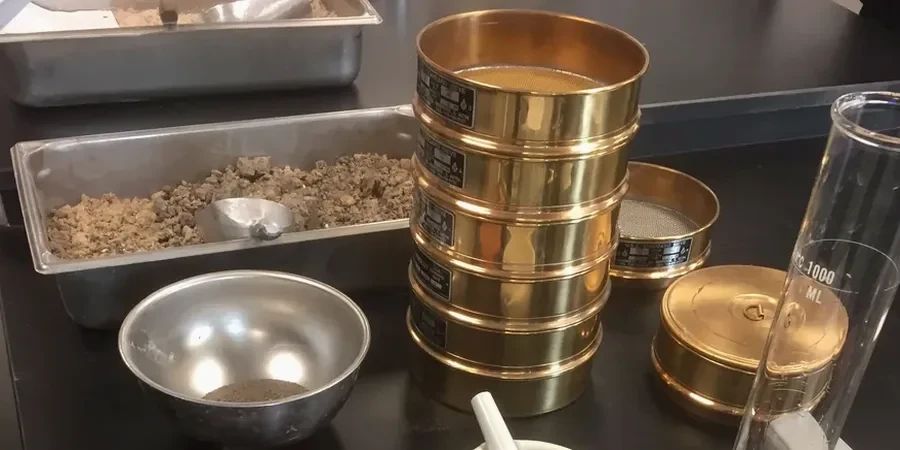
The first thing we set up on a Hampton soft-ground tunnel job is the triaxial cell and the incremental consolidation frame. You need to know how much pore pressure that silty clay can hold and how fast it will settle once you start the TBM or cut open the face. Hampton sits on the Atlantic Coastal Plain, barely 3 meters above mean sea level, with the water table often less than 2.5 meters below grade. That means every sample we receive is fully saturated and needs back-pressure saturation in the lab before we run a consolidated-undrained test. Our team handles the full sequence: extruding Shelby tubes, trimming specimens, running grain-size analysis to verify the fines fraction, and then loading the triaxial cell for effective stress paths. In a city where the Yorktown Formation clay dominates the upper 10 to 15 meters, getting the undrained shear strength right is the difference between a stable face and a blowout.

In Hampton, the undrained shear strength of the Yorktown clay often dictates face pressure on the TBM; we run CU triaxials at in-situ confining stress to give the contractor a number they can trust.
Our service areas

Our approach and scope

Hampton recorded its last significant seismic event in 2011 with the Mineral, Virginia earthquake, a magnitude 5.8 that reminded engineers across the region that the Coastal Plain doesn't require a local epicenter to amplify ground motion. For tunnel design in soft ground, that seismic history means we don't just look at static stability. We model cyclic degradation of the clay using strain-controlled triaxial tests and pair the results with a seismic-refraction survey to map the top of the competent Yorktown Formation below the soft alluvium. The city's population is roughly 137,000, and the ongoing expansion of the Hampton Roads Bridge-Tunnel has pushed demand for specialized lab testing far beyond routine index properties. What we see most often are interbedded silts and clays with organic lenses near the Back River and Hampton River tributaries. Those organics drive the Atterberg limits into CH territory, and the atterberg-limits data feeds directly into the soil behavior type classification we use for numerical modeling. Another layer we always check is the intact consolidation yield stress with an oedometer; the overconsolidation ratio in these clays is often less than 2, which places the tunnel squarely in normally consolidated to lightly overconsolidated ground.
Geotechnical Analysis for Soft Soil Tunnels in Hampton, Virginia
Technical reference — Hampton Virginia

Site-specific factors

What we notice repeatedly in Hampton is that the soft clay doesn't just squeeze; it swells when the confining pressure drops. After a tunnel lining is installed, the annulus grout can pressurize the ground faster than the pore water can drain, and you get a delayed face heave that nobody budgeted for. The real risk isn't just face collapse, it's the long-term consolidation settlement that shows up six months after the TBM has passed under a neighborhood like Phoebus. If the lab data under-reports the compression index by even ten percent, the predicted settlement is wrong by the same margin, and that can mean cracked utilities and angry residents. We insist on incremental load oedometer tests with load increments held for twenty-four hours when organics exceed five percent, because the secondary compression in these clays is not a rounding error, it's a design parameter.

Need a geotechnical assessment?

Reply within 24h.

Email: contact@geotechnical-engineering.vip

Regulatory framework

ASTM D4767 – Consolidated-Undrained Triaxial Compression Test, ASTM D2435 – One-Dimensional Consolidation Properties of Soils, ASTM D4318 – Atterberg Limits, IBC Chapter 18 – Soils and Foundations, ASCE 7-22 – Minimum Design Loads for Buildings and Other Structures

Reference parameters

ParameterTypical value
Typical undrained shear strength (su), Yorktown clay25–65 kPa
Liquidity index range, near-surface organic silts0.8–1.4
Overconsolidation ratio (OCR), Hampton alluvium1.2–2.5
Coefficient of consolidation (cv), silty clay1.5–4.0 m²/year
Fines content (<75 µm), tunnel horizon samples70–98%
Plasticity index (PI), organic CH clays28–55%
Saturated unit weight, typical17.5–19.2 kN/m³

Common questions

What is the typical cost range for a soft-ground tunnel geotechnical lab program in Hampton?

For a tunnel project in Hampton, the lab testing program typically falls between US$4,710 and US$15,590, depending on the number of Shelby tube samples, the triaxial test count, and whether we run incremental consolidation with secondary compression on every tube or on selected specimens. A small-diameter utility tunnel with a limited sampling program will sit at the lower end; a larger-diameter TBM drive with multiple cross-sections and a full suite of CU triaxials, oedometers, and index tests on every sample will move toward the upper end.

How do you handle the high groundwater in Hampton when testing soft clay samples for tunneling?

All samples arrive in sealed Shelby tubes, and we extrude them in a humidity-controlled room. Because Hampton's water table is so shallow, the specimens are nearly always fully saturated, which is actually an advantage for triaxial testing: we apply back-pressure saturation in the triaxial cell and confirm a Skempton B-value of at least 0.95 before shearing. For consolidation tests, we keep the oedometer cell flooded from the start to prevent any drying that would alter the compression curve.

What lab tests are most critical for a TBM tunnel in Hampton's Yorktown clay?

The non-negotiable tests are consolidated-undrained triaxial compression at the in-situ confining stress, incremental load oedometer consolidation to get the compression and recompression indices, and Atterberg limits with natural moisture content on every tube. If the log shows organic lenses, we add loss-on-ignition and extend the consolidation load steps to capture secondary compression. For TBM face pressure calculations, the undrained strength ratio from the CU triaxial is the number the contractor will ask for first.

Location and service area

We serve projects in Hampton Virginia and surrounding areas.

View larger map