GEOTECHNICAL ENGINEERING
HAMPTON VIRGINIA
HomeFoundationsRaft/mat foundation design

Raft/Mat Foundation Design in Hampton Virginia

Rigorous testing. Clear reporting.

LEARN MORE

The Yorktown Formation marine clays under Hampton, Virginia dictate a specific foundation approach near sea level. A surface elevation of just 3 meters combined with a groundwater table often less than 2 meters deep means differential settlement becomes the controlling design parameter, not bearing capacity. We design mat foundations that distribute structural loads across a continuous slab, turning a problematic soil profile into a workable bearing platform. For coastal commercial buildings in the Coliseum Central district and industrial warehouses near Langley Air Force Base, we integrate the CPT test to map stratigraphy before selecting the mat thickness and reinforcement schedule. Hampton's proximity to the Chesapeake Bay introduces sulfidic soils in some zones, so our mix designs specify sulfate-resistant cement where needed. The 2011 Virginia earthquake reminded everyone that the Atlantic Seaboard fall line isn't the only seismic source — long-period motion from the Central Virginia Seismic Zone still reaches Hampton Roads, which a rigid mat handles far better than isolated footings.

In Hampton's marine clays, secondary compression isn't a textbook footnote — it's 30% of your long-term settlement budget.

Our service areas

Our approach and scope

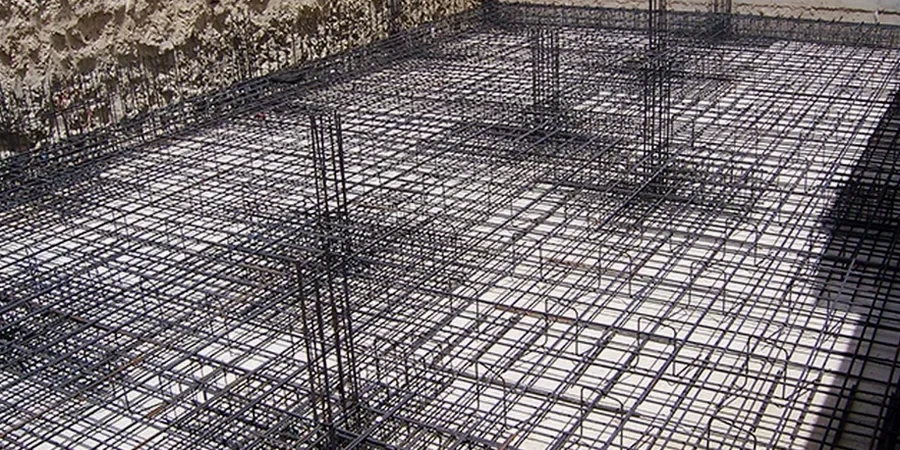
Hampton's position on the Virginia Peninsula creates a dual foundation challenge: marine transgressions deposited compressible silty clays, while the upland areas west of I-64 transition into residual sandy silts from weathered Coastal Plain sediments. The humidity swings — from 90% summer saturation to freeze-thaw cycles in January — demand mat foundations with low water-cement ratios and proper curing protocols. We design to IBC 2021 Chapter 18 and ASCE 7-22, calculating the modulus of subgrade reaction from field plate load data rather than textbook correlations. Thicknesses range from 450 mm for lightly loaded slab-on-grade to over 1,000 mm for heavy rack-supported warehouses. Reinforcement follows ACI 318-19, with top and bottom mats in high-moment regions. For sites within the FEMA AE flood zone along the Hampton River, we coordinate with the stone columns team to provide ground improvement beneath the mat, reducing total and differential settlement before the structural slab is cast. Our laboratory runs one-dimensional consolidation tests per ASTM D2435 on undisturbed Shelby tube samples to calibrate the settlement predictions, because in Hampton's soils, secondary compression can account for 30% of long-term movement.
Raft/Mat Foundation Design in Hampton Virginia
Technical reference — Hampton Virginia

Site-specific factors

The risk profile changes sharply between Buckroe Beach and the Mercury Boulevard corridor. Buckroe sits on clean sands with relatively fast drainage — a mat foundation there fails from erosion and scour if the slab edge isn't deepened or protected. Along Mercury Boulevard, the geologic map shows the Tabb Formation: stiff, overconsolidated clays that look competent in a hand sample but soften dramatically when exposed to water for more than 48 hours. We've seen mat foundations in Hampton underdesigned because someone assumed 150 kPa bearing from a pocket penetrometer reading taken in dry weather. A proper slope stability assessment becomes critical at sites like the Hampton University waterfront, where the mat's edge restraint interacts with a failing natural slope. Without site-specific consolidation testing, a mat foundation in Hampton can tilt 25 mm in five years — not enough to collapse, but enough to bind doors, crack partition walls, and void the manufacturer's warranty on automated warehouse equipment.

Need a geotechnical assessment?

Reply within 24h.

Email: contact@geotechnical-engineering.vip

Regulatory framework

IBC 2021 — International Building Code (adopted by Virginia with amendments), ASCE 7-22 — Minimum Design Loads and Associated Criteria for Buildings and Other Structures, ACI 318-19 — Building Code Requirements for Structural Concrete, ASTM D1196 — Standard Test Method for Nonrepetitive Static Plate Load Tests of Soils and Flexible Pavement Components, ASTM D2435 — Standard Test Methods for One-Dimensional Consolidation Properties of Soils Using Incremental Loading, FEMA Flood Insurance Rate Map (FIRM) — City of Hampton Panel 515530

Reference parameters

ParameterTypical value
Design standard (gravity loads)IBC 2021 Chapter 18, ASCE 7-22
Seismic provisionsASCE 7-22 Chapter 12 (Site Class D/E)
Concrete reinforcementACI 318-19 (top and bottom mats)
Modulus of subgrade reactionPlate load test (ASTM D1196) — field derived
Settlement analysis method1D consolidation (ASTM D2435) + Schmertmann method for sands
Typical mat thickness range450 mm (light commercial) to 1,200 mm (heavy industrial)
Sulfate exposure classACI 318-19 Class S2/S3 (Chesapeake Bay proximity)
Groundwater controlPermanent dewatering or cutoff walls if GWL < 1.5 m from base

Common questions

What's the cost range for raft/mat foundation design on a commercial lot in Hampton?

Design fees for a mat foundation in Hampton typically range from US$1,000 for a straightforward single-story slab-on-grade on competent soils to US$4,780 for a multi-bay warehouse requiring full 3D finite element analysis, consolidation testing, and coordination with ground improvement contractors. The final figure depends on building footprint, column loads, and how much of the Yorktown clay needs lab characterization.

Why choose a mat foundation over isolated footings in Hampton's soils?

Hampton's marine clays exhibit high compressibility and secondary consolidation. Isolated footings at different depths can settle differentially by 15-25 mm, causing structural distortion. A continuous mat bridges soft zones, reduces differential movement, and provides a better solution for the fluctuating groundwater table common across the Virginia Peninsula.

How do you account for Hampton's high groundwater table in mat design?

We design for buoyancy forces and hydrostatic uplift per ASCE 7-22 Section 5.3. When the groundwater table is within 1.5 meters of the mat base, we incorporate under-slab drainage layers, sump pump provisions, or permanent dewatering cutoffs. For flood zones along the Hampton River, the mat thickness and reinforcement are increased to resist saturated soil pressures.

What lab tests do you run on the soil before designing the mat?

One-dimensional consolidation (ASTM D2435) on undisturbed Shelby tube samples is essential to quantify the compression index and secondary compression ratio. We also run unconsolidated-undrained triaxial tests for short-term bearing, Atterberg limits to classify the clay, and sulfate content analysis when Chesapeake Bay proximity suggests potential concrete degradation.

Does IBC 2021 require a specific factor of safety for mat foundations?

IBC 2021 Section 1806 references ASCE 7-22 for load combinations and a minimum factor of safety of 2.5 against bearing capacity failure for shallow foundations. For settlement, we limit total movement to 25 mm and differential settlement to 19 mm for conventional structures. Tighter tolerances apply for rack-supported warehouses — usually 12 mm maximum differential.

Location and service area

We serve projects in Hampton Virginia and surrounding areas.

View larger map