GEOTECHNICAL ENGINEERING
HAMPTON VIRGINIA
HomeIn-Situ TestingField density test (sand cone method)

Field Density Testing in Hampton, VA — Sand Cone Method

Rigorous testing. Clear reporting.

LEARN MORE

Coastal Virginia geology demands precision. In Hampton, where the Atlantic Coastal Plain transitions into the Chesapeake Bay estuary, subsurface conditions shift from clean sands to high-plasticity silts within a single block. The marine clay lenses underlying neighborhoods like Phoebus and Wythe require compaction verification that accounts for tidal groundwater fluctuations. Our field density test program deploys the sand cone method alongside complementary in-situ permeability assessments when the water table sits less than four feet below grade — a common scenario across the Hampton Roads peninsula. The sand cone procedure, governed by ASTM D1556, provides direct measurement of in-place soil density, a parameter that nuclear gauges often misread in the iron-rich residual soils found near Langley AFB. Contractors working on I-64 expansion or subdivision grading in the Coliseum Central corridor rely on this data to meet VDOT compaction specifications without risking post-construction settlement in the underlying Yorktown Formation sediments.

A sand cone test on Hampton's Tabb Formation sands delivers density values that nuclear gauges can overestimate by 3-5 pcf due to elevated background iron content.
Our service areas

Our approach and scope

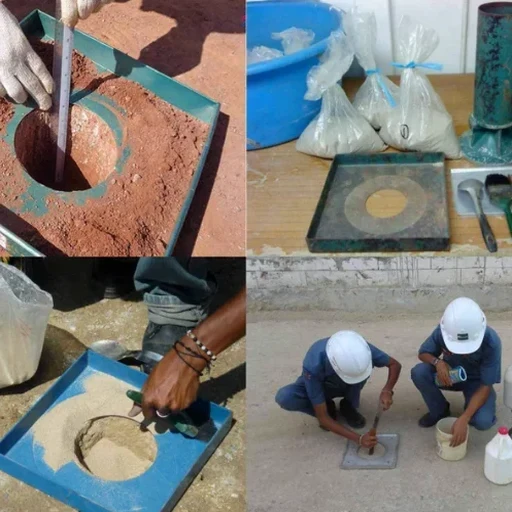
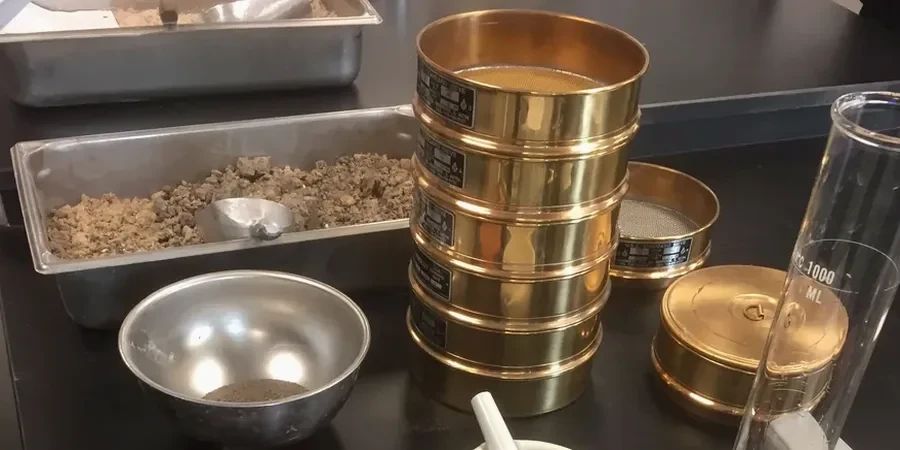
The geology beneath Hampton tells a story of repeated marine transgressions. The uppermost strata consist of Pleistocene-age sands and gravels of the Tabb Formation, underlain by the Pliocene Yorktown Formation — a calcareous, fossiliferous sand and clay unit that extends to depths exceeding 100 feet in some areas. Compaction control on these materials must account for the angular, broken shell fragments that increase internal friction but reduce the reliability of indirect density measurements. Our technicians extract a calibrated volume of Ottawa sand through a cone plate seated directly on the compacted lift, weighing the excavated material to compute wet density, then applying a laboratory-derived moisture correction from grain size analysis performed on the same sample. The difference between field density and the modified Proctor maximum — typically specified at 95% for structural fill under IBC Section 1805 — determines pass or fail. When granular soils near the Hampton Roads Beltway show marginal results, we integrate vibrocompaction recommendations that pre-densify the upper 15 to 20 feet before pad certification begins, eliminating the risk of differential settlement under mat foundations.
Field Density Testing in Hampton, VA — Sand Cone Method
Technical reference — Hampton Virginia

Site-specific factors

Fill performance varies dramatically between Hampton's inland subdivisions and the waterfront communities along the Hampton River. In the Fox Hill area, well-drained sands compact predictably and achieve 98% modified Proctor with standard vibratory rolling. Contrast that with the deep organic silts encountered near Buckroe Beach, where compaction lifts laid over soft subgrade can pass a sand cone test today yet settle two inches within six months as pore pressures dissipate. The primary risk is a false positive: a density reading that meets specification but masks an unstable underlying layer. Our protocol addresses this by coupling density testing with plate load tests on the first lift, verifying that the subgrade reaction modulus exceeds 150 pci before structural fill placement continues. Another concern is moisture sensitivity — Hampton's average 47 inches of annual rainfall can push fine-grained borrow soils past optimum moisture content within hours, requiring reworking and retesting that delays foundation inspections.

Need a geotechnical assessment?

Reply within 24h.

Email: contact@geotechnical-engineering.vip

Watch the video

Regulatory framework

ASTM D1556 — Standard Test Method for Density and Unit Weight of Soil in Place by Sand-Cone Method, ASTM D698 — Standard Test Methods for Laboratory Compaction Characteristics Using Standard Effort (12,400 ft-lbf/ft³), ASTM D1557 — Modified Proctor (56,000 ft-lbf/ft³), AASHTO T 191 — Density of Soil In-Place by the Sand-Cone Method, IBC Section 1805 — Dampproofing and Waterproofing / Fill Requirements, VDOT Road & Bridge Specifications, Section 303 — Earthwork

Reference parameters

ParameterTypical value
Applicable standardASTM D1556 / AASHTO T 191
Maximum test depth6 inches (single lift), deeper with stepped excavation
Minimum test hole volumeRelated to maximum particle size (typically 800-1200 cm³)
Calibration sandASTM C778 20-30 Ottawa sand, bulk density certified per D1556 Annex
Typical moisture correctionOven-dry per ASTM D2216, field moisture balance acceptable for rapid QC
Compaction specification referenceIBC 1805.5, VDOT Road & Bridge Specifications Section 303
Frequency of testingOne test per 1,500-2,500 sq ft per lift (VDOT), higher for critical structural fill

Common questions

What is the typical cost for a sand cone density test in Hampton, Virginia?

For projects within the Hampton Roads area, field density testing using the sand cone method ranges from US$80 to US$170 per test, depending on mobilization distance, number of tests per visit, and whether laboratory Proctor data already exists. Most earthwork contractors schedule 8-15 tests per day to keep per-unit costs at the lower end of that range.

How does the sand cone method compare to a nuclear density gauge on coastal Virginia soils?

The sand cone method provides a direct physical measurement of density — you excavate, weigh, and calculate. Nuclear gauges measure radiation attenuation, which is affected by the iron content and mineralogy of Hampton's Yorktown Formation sediments. In iron-rich coastal deposits, a nuclear gauge can overestimate density by 3 to 5 pounds per cubic foot. The sand cone eliminates that bias, making it the preferred referee method under VDOT specifications when nuclear gauge readings are disputed.

How many sand cone tests does VDOT require per lift?

VDOT Road & Bridge Specifications Section 303 typically requires one field density test per 1,500 to 2,500 square feet of compacted area per lift, with a minimum of three tests per lift for smaller areas. For structural fill supporting foundations under IBC Section 1805, testing frequency increases to one test per 1,000 square feet, with additional tests at random locations selected by the geotechnical engineer of record.

Can a sand cone test be performed when the water table is high?

Yes, but with limitations. In Hampton, where the water table often sits 3 to 6 feet below grade, the test hole must remain dry during excavation and sand pouring. If groundwater infiltrates the hole — common in the low-lying areas near Newmarket Creek — the test is invalid and must be relocated. For consistently wet conditions, we recommend complementing sand cone density with a CPT test to profile density continuously without excavation.

Location and service area

We serve projects in Hampton Virginia and surrounding areas.

View larger map