GEOTECHNICAL ENGINEERING
HAMPTON VIRGINIA
HomeSeismicBase isolation seismic design

Base Isolation Seismic Design in Hampton, Virginia: A Technical Perspective

Rigorous testing. Clear reporting.

LEARN MORE

Working in Hampton, you quickly learn that the ground here has a memory. The loose, compressible sediments of the Atlantic Coastal Plain, deposited over millennia and shaped by the Chesapeake Bay impact crater, don't behave like the stiff clays you find further inland. When a client brings plans for a new essential facility near the Coliseum Central district, one of the first things our team reviews is the site's response to long-period ground motion. The local geology, with its deep layers of sand and silt, can amplify seismic waves in ways that surprise engineers unfamiliar with the Tidewater region. Integrating a site-specific response spectrum early on allows us to tailor the base isolation system parameters precisely, rather than relying on generic code assumptions. We often pair this with a thorough seismic refraction survey to map the shear wave velocity profile across the site, identifying any hidden paleochannels that could alter the dynamic behavior of the structure above its isolators.

In Hampton's coastal geology, a well-tuned base isolation system doesn't just reduce drift; it fundamentally changes how the structure communicates with the amplified ground motions of the Tidewater sediments.

Our service areas

Our approach and scope

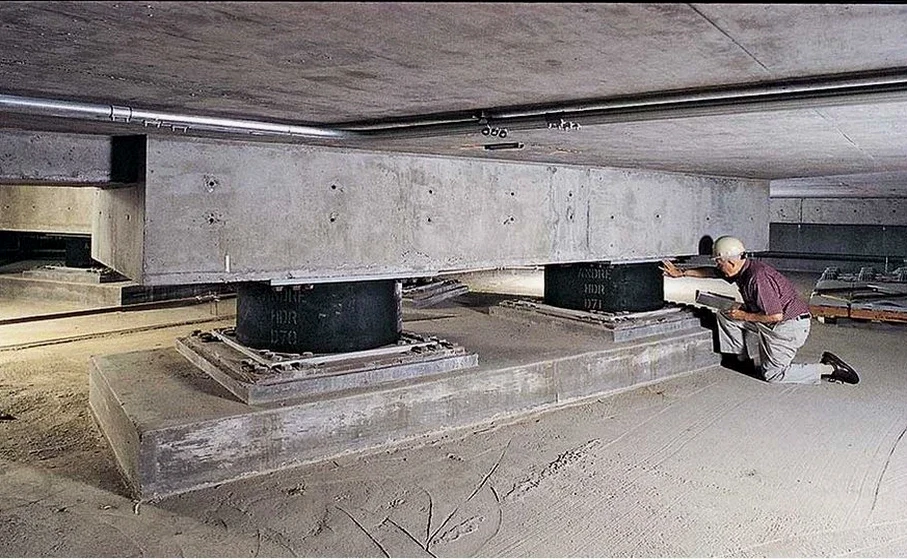
Hampton sits at roughly 37 degrees north latitude, a location that has witnessed everything from the 2011 Virginia earthquake felt across the Peninsula to the constant, subtle subsidence affecting the coastline. Designing base isolation here isn't just about picking a catalog elastomeric bearing. The design must account for the city's characteristic soil profile: interbedded sands, silts, and soft clays of the Norfolk Formation, often with a shallow water table that complicates foundation work. We rely on high-damping rubber bearings and friction pendulum systems, but the real engineering lies in the ground-motion characterization. Through comprehensive CPT testing across the building pad, we can delineate the stratigraphy and estimate the dynamic properties needed for a nonlinear time-history analysis. This data feeds directly into the isolator displacement demands, ensuring the system can accommodate the maximum considered earthquake without pounding against the moat walls. The goal is a design that keeps the superstructure elastic, protecting critical equipment and architectural finishes from drift damage.
Base Isolation Seismic Design in Hampton, Virginia: A Technical Perspective
Technical reference — Hampton Virginia

Site-specific factors

Much of downtown Hampton and the area around Phoebus grew during an era when urban fill was the standard solution for low-lying ground. We've unearthed everything from old timber piles to buried brick rubble during site investigations here. That kind of uncontrolled fill layer, sitting just a few feet below the slab, presents a real challenge for base-isolated structures. The differential settlement across a large mat foundation can tilt the isolators, locking them up or reducing their effective period. Before we finalize any isolation system, we analyze the long-term consolidation behavior of these legacy fill pockets. If the risk is too high, we might recommend a ground improvement program like stone columns to stiffen the mass and provide a more uniform bearing stratum. Overlooking these urban soil conditions is how you end up with a building that's theoretically isolated but practically restrained by its own uneven support.

Need a geotechnical assessment?

Reply within 24h.

Email: contact@geotechnical-engineering.vip

Regulatory framework

ASCE 7-22: Minimum Design Loads and Associated Criteria for Buildings and Other Structures, IBC 2021: International Building Code, ASTM D7400-19: Standard Test Methods for Downhole Seismic Testing, AASHTO Guide Specifications for Seismic Isolation Design

Reference parameters

ParameterTypical value
Design Spectral Acceleration (SDS) at short periodDetermined per ASCE 7-22 Chapter 11 site coefficients
Isolator Displacement Capacity (DM)Calculated for MCER, typically exceeding 24 inches for Tidewater soil amplification
Effective Damping Ratio15-30% for high-damping rubber bearings per prototype testing
Wind Restraint CapacityDesigned for ASCE 7-22 ultimate wind speeds, with fuse-bolt mechanisms common
Uplift RestraintProprietary sliding bearings with tensile capacity for tall, slender structures
Isolation System PeriodTarget 2.5 to 4.0 seconds to avoid dominant site period
Moat Wall ClearanceSet at 1.2 x maximum total displacement vector sum

Common questions

How does the Chesapeake Bay impact crater geology affect base isolation design in Hampton?

The reference range for this service in Hampton Virginia is US$3.940 - US$9.580. The final price depends on the project scope and volume.

What is the typical cost range for a base isolation design package on a mid-rise project in Hampton?

For a typical new essential facility or mid-rise structure in Hampton, the complete design package including ground motion characterization, nonlinear time-history analysis, peer review, and construction administration support generally falls between US$3,940 and US$9,580. The final fee depends on the structural complexity, number of isolators, and the extent of site-specific geophysical testing required.

Can base isolation be retrofitted to an existing historic building in the Hampton downtown area?

Yes, we have experience with seismic retrofit isolation for existing structures. The process involves lifting the building from its current foundation, installing a new structural diaphragm, and placing isolators. In Hampton's older districts, this requires careful assessment of the existing masonry and timber framing to ensure the load path can be transferred without damaging the historic fabric. We often use flat-jack testing and minor coring to verify material strengths before proceeding.

How do you validate that the isolators will perform under Hampton's specific soil amplification?

We validate performance through three-dimensional nonlinear response-history analysis using a suite of at least eleven ground motion pairs. These motions are spectrally matched to our site-specific target spectrum. We check maximum isolator displacement, residual drift, and floor response spectra. The analysis confirms the system meets the ASCE 7-22 stability and performance criteria for the Maximum Considered Earthquake.

Location and service area

We serve projects in Hampton Virginia and surrounding areas.

View larger map